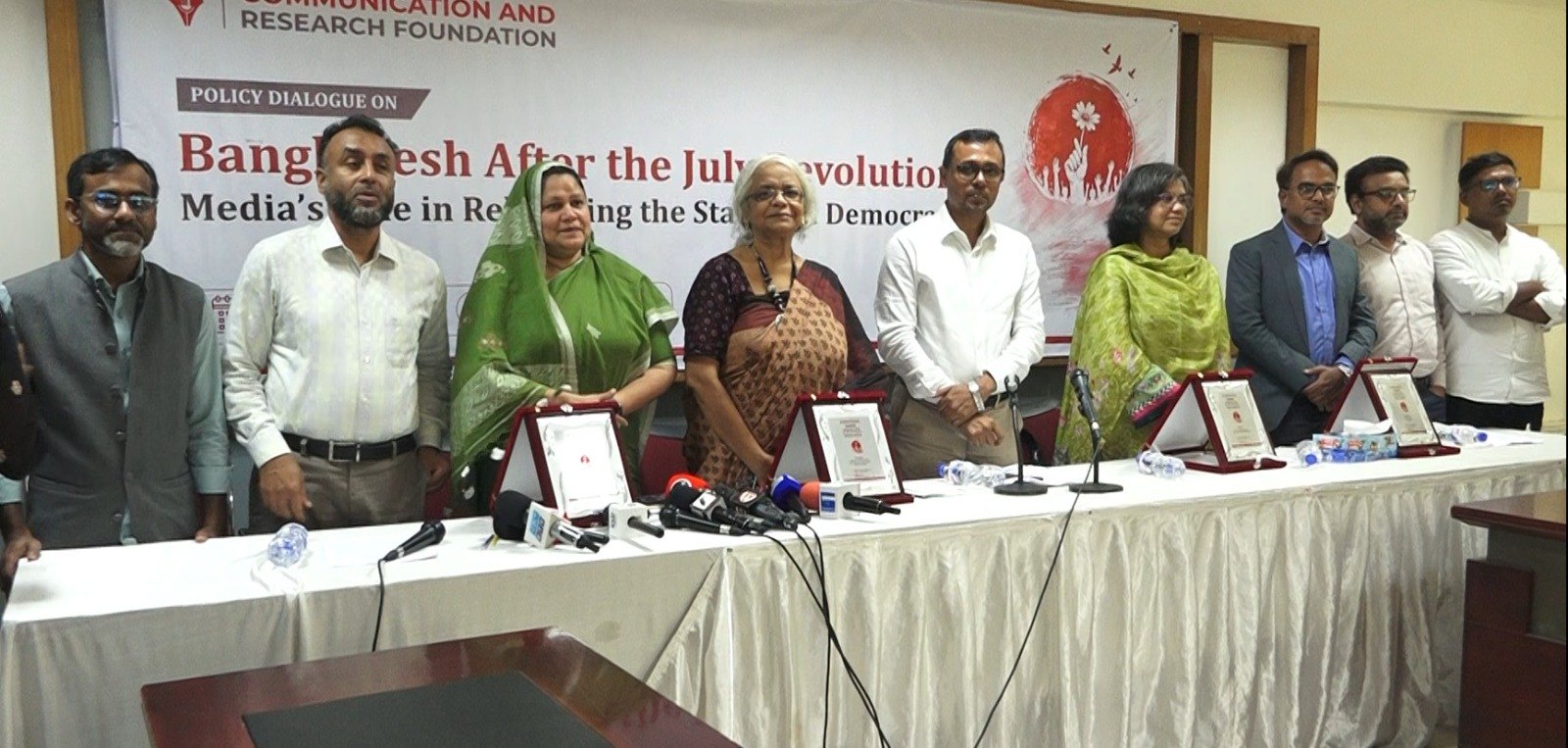
A policy dialogue titled “Bangladesh after the July Revolution: The Role of Media in Rebuilding the State and Democracy” was organised by the Communication and Research Foundation (CRF), at the National Press Club in Dhaka on 29 July 2026. Bringing together academics, media professionals, political representatives and policy makers. The dialogue examined the condition of Bangladesh’s media after the July 2024 and its potential role in democratic transition and state reconstruction. The discussion revealed that meaningful democratic reconstruction would not be possible without an independent, professional and publicly accountable media. Although the July uprising generated expectations of political and institutional change, speakers observed that the overall media environment had not substantially improved. Public trust remained weak, journalists and media institutions continued to face insecurity, and the recommendations of the Media Reform Commission had yet to receive meaningful implementation. Participants identified state control, political interference, influence from security agencies, corporate ownership, commercial pressure, insecure employment and inadequate remuneration as major structural barriers to independent journalism. They argued that restoring public confidence would require more than regulatory changes. It would also require changes in the attitudes and practices of political actors, media owners, journalists and news audiences. The dialogue therefore called for an independent media commission, stronger legal and professional protection for journalists, greater editorial autonomy, fact-based reporting, institutional accountability and implementation of existing reform proposals. It also stressed that the media should counter social division and misinformation through accurate, responsible and public-interest journalism. The event ultimately framed media reform not as a sectoral concern, but as a fundamental condition for rebuilding democratic institutions and sustaining the aspirations associated with the July mass uprising.